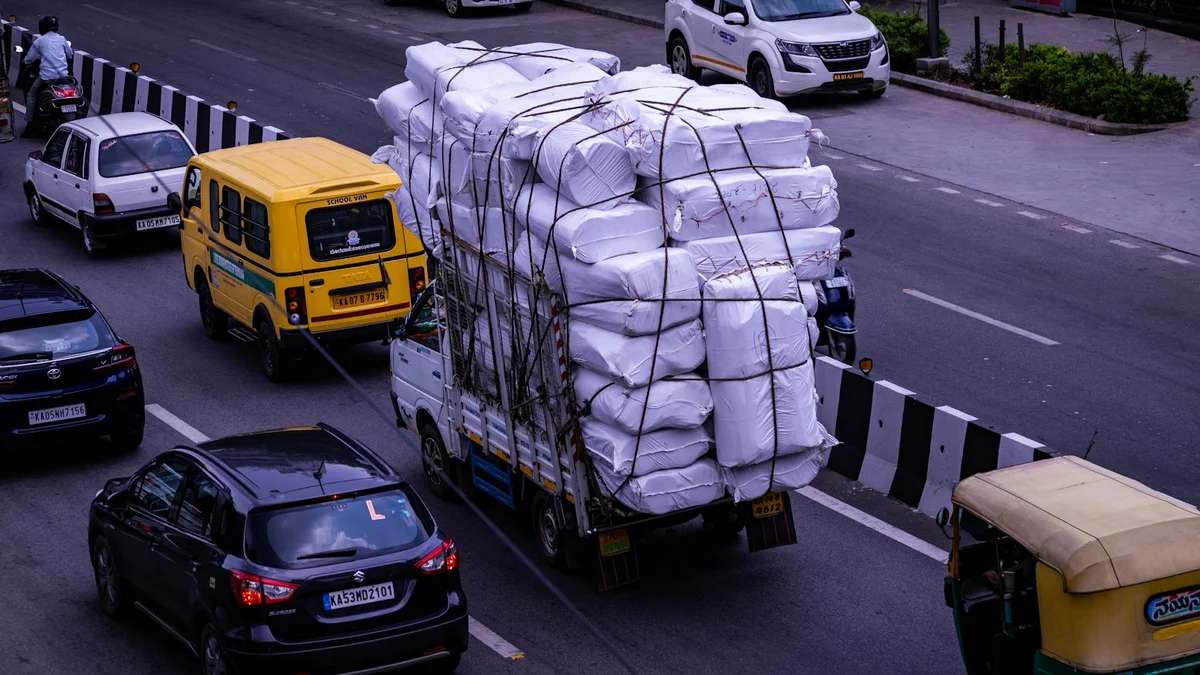
Short answer: a bilty, also called a lorry receipt (LR), is the receipt a transport company issues when it accepts goods to carry by road. It records the sender, the receiver, the origin, the destination and the number of packages. Wholesale orders, especially bulky textile parcels, usually travel by transport company with a bilty. Smaller orders often go by courier with a tracking number. You collect a transport parcel from the transporter's office in your city using the bilty.
Transport vs courier
| Question | Transport (bilty) | Courier |
|---|---|---|
| Best for | Larger, heavier orders (bales, cartons) | Samples and small orders |
| Cost | Usually cheaper per kg for bulk | Usually higher per kg, cheaper for small parcels |
| Delivery | Usually collected from the transporter's local office (door delivery sometimes available) | Usually to your door |
| Tracking | Bilty number; call the transporter's office | Online tracking number |
| Proof of dispatch | A photo of the bilty | The tracking number and the courier receipt |
What's on a bilty
- The bilty or LR number and date
- The transport company's name, booking branch and destination branch
- The consignor (sender) and consignee (receiver)
- The number of packages and often their weight
- Freight charges, and whether they are paid by the sender or to pay by the receiver on delivery
Check that your name and city are correct and the package count matches what the supplier told you.
How shipping a wholesale order usually works
- Agree on the transporter. Ask the supplier which transport companies serve your city, or name the one you already use. Agree who pays the freight.
- The supplier packs and books the parcel at the transporter's booking office and receives the bilty.
- The supplier sends you a photo of the bilty as proof of dispatch. Ask for it before paying any balance.
- Track it by calling the transporter's destination office with the bilty number.
- Collect it from the destination office with the bilty (or its number) and your ID, and pay the freight if it is "to pay".
Avoiding delays, damage and lost parcels
- Count the packages before you sign for them at the transporter's office, and check for torn or wet packing.
- Photograph or video the unboxing, especially of a new supplier's first order. It helps with any damage or short-count claim.
- Ask for waterproof packing in the monsoon. Textile bales are often wrapped in plastic under the outer cover.
- Allow extra time before festivals, when transporters are busiest. See our festive wholesale calendar.
- Ask which documents must travel with the goods. The supplier and transporter will know what's needed for your order's value and route.
- Collect promptly. Some transporters charge for storage if a parcel isn't collected within a set time.
If the parcel doesn't arrive
First, call the destination office with the bilty number. If they have no record, ask the supplier to check with the booking office. Remember that a real bilty from a real transporter can be verified: call the transport company's office directly, using a number you find yourself, not one the supplier gives you. If the bilty turns out to be fake, see what to do if a supplier doesn't deliver.
Frequently asked questions
What is bilty in transport?
A bilty, or lorry receipt (LR), is the receipt a transport company issues when it accepts goods for road delivery. It is your proof that the goods were handed over for dispatch.
What is the difference between bilty and LR?
None: bilty is the common name for a lorry receipt (LR). It is also called a goods receipt (GR) or consignment note.
What does "to pay" mean on a bilty?
The receiver pays the freight when collecting the parcel. "Paid" means the sender has already paid it.
Should I use transport or courier for my first order?
For samples and small first orders, courier is simpler and fully trackable. Switch to transport once your orders are large enough that freight per kg matters.
Related: Surat textile market guide · supplier checklist